
A quantum leap: Georgia Southern student advances research on the world stage
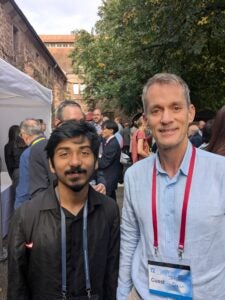
When Georgia Southern University student Anish Goyal arrived on the Statesboro Campus in fall 2023, he already had 63 hours of college credit and a clear goal: to dive into research that bridges computer engineering, physics and mathematics. Recently, his dedication took him across the world to learn from some of the brightest minds in science.
Goyal — a second-year Honors College student majoring in computer engineering — was selected to attend the Heidelberg Laureate Forum in Heidelberg, Germany. The annual event brings together 200 of the world’s top young researchers in mathematics and computer science to network with laureates who have received the Fields Medal, the Turing Award, the Abel Prize and other top honors in the STEM disciplines.
Goyal was one of only four undergraduates invited to the forum. Most attendees were Ph.D. candidates or postdoctoral researchers.
“At first, it was intimidating,” Goyal said. “I got to speak with the person who wrote my operating systems textbook. But over time, I realized the laureates were generous with their time and treated students as colleagues in training rather than guests on the sidelines.”
The experience deepened his interest in quantum computing — a field he describes as the frontier where physics, engineering and computation meet.
“Quantum computing offers new ways to model systems where classical simulations struggle,” Goyal said. “Better computational models could lead to safer batteries, clearer climate predictions and more efficient drug design.”
Goyal’s path to Georgia Southern began in high school at the Gwinnett School of Mathematics, Science, and Technology near Atlanta. After taking 17 Advanced Placement courses and dual-enrolling at Georgia Gwinnett College, he spent the summer of 2023 at Georgia Southern as part of the Governor’s Honors Program (GHP) — an experience that solidified his decision to enroll at the University.
“GHP was one of the most pivotal, transformative experiences of my life,” he said. “I built a robotic hand that could fingerspell American Sign Language from spoken words. That project made me realize how engineering connects human needs with problem solving.”
Since joining the Honors College, Goyal has pursued research across departments. Working with Mark Edwards, Ph.D., a professor of physics, he helped develop a quantum-based rotation sensor for inertial navigation. With Hossein Taheri, Ph.D., associate professor of manufacturing engineering, he contributed to ConcreteNet, a deep learning model that analyzes radar images to detect infrastructure defects for the Georgia Department of Transportation.
His research has already reached an international audience as he participated in an event for the world’s largest technical professional organization. Last spring, he presented at the Institute of Electrical and Electronics Engineers International Symposium on Underwater Technology in Taiwan, sharing his work on an underwater robot inspired by zebrafish neural patterns.
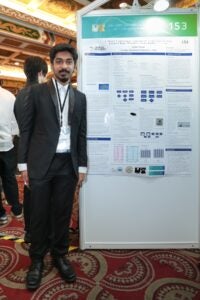
“The conference taught me how to communicate complex ideas clearly and connect with researchers from different disciplines,” he said.
Looking ahead, Goyal plans to pursue a Ph.D. in quantum science and engineering, with hopes of designing solid-state devices that make quantum bits, or qubits, more stable and easier to control.
“My time at Georgia Southern has shown me the value of mentorship and collaboration,” he said. “Research progress happens when people share knowledge freely. That’s the kind of environment I want to build wherever I go next.”