
1. Summary
The Hazardous Chemical Protection and Right-to-Know Plan is imperative for communicating workplace chemical hazards to employees. This plan lays out the responsibilities for all employees at Georgia Southern University and the required administrative controls for managing this plan in the workplace. This plan was developed for Georgia Southern University (GS) to protect employee health and safety through compliance with the State of Georgia Public Employees Hazardous Chemical Protection and Right-to-Know Act of 1988 as amended and the Georgia Department of Labor Safety Engineering Section Chapter 300-3-19. This plan also includes the updated version of O.C.G.A.2015 Georgia Code Title 45 – Public Officers and Employees Chapter 22 – Public Employee Hazardous Chemical Protection and Right to Know. No employee of GS shall be discharged, disciplined or discriminated against for exercising their rights under this plan. Any employee adversely affected for exercising their rights under this plan may file a grievance in accordance with GS’s established grievance procedures. Employees dissatisfied with the final decision of an appointed authority may file a grievance with the State of Georgia Office of Insurance and Safety Fire Commissioner.
2. Purpose
To ensure employee health and safety is protected from the harmful effects of hazardous materials by providing guidance for communicating and training employees who may be exposed to hazardous materials in the course of their work at Georgia Southern University.
3. Scope
All employees who are “subjected to a hazardous chemical in the course of employment through any route of entry including, but not limited to, inhalation, ingestion, skin contact or absorption, including potential or accidental exposure” (GA D.O.L. Safety Engineering Section Chapter 300-3-19-.01, 1993) in all workplaces of GS shall comply with this Right-to-Know Plan. This written plan is available at the Office of Research Integrity Industrial Hygiene webpage.
4. Exclusions
The following items, articles, and products are not subject to the requirements of the Right-to-Know Plan:
- Impurities which develop as intermediate materials during chemical processing but are not present in the final mixture and to which employee exposure is unlikely;
- Alcoholic beverages and articles intended for personal consumption by employees in the workplace;
- Any consumer product which can be demonstrated as being used in the workplace in the same manner as it would be during normal consumer use and which use results in a duration and frequency of exposure which is not greater than exposures experienced by consumers;
- Articles sold or used in retail food establishments and retail trade establishments;
- Chemicals which are merely being transported in the state as part of a shipment of interstate or intrastate commerce; and
- Chemicals or mixtures which may be hazardous but which are covered by the federal Atomic Energy Act.
5. References
- State of Georgia Public Employees Hazardous Chemical Protection and Right-to-Know Act of 1988 -O.C.G.A. § 45-22-6.
- State of Georgia Department of Labor Safety Engineering Section Chapter 300-3-19.
- State of Georgia Administrative Procedures Act O.C.G.A § 50-13-1
6. Definitions
- Chemical name: “Scientific designation of a chemical in accordance with a nomenclature system developed by the International Union of Pure and Applied Chemistry (IUPAC) or the Chemical Abstracts Service” (GA D.O.L. Safety Engineering Section Chapter 300-3-1 9-.01, 1993).
- Common name: “Any designation or identification such as code name, code number, trade name, or brand name used to identify a chemical other than by its chemical name” (GA D.0.L. Safety Engineering Section Chapter 300-3-19-.01, 1993).
- Basic Chemical Right-to-Know Training: Training provided to all employees of GS during the onboarding process with refreshers provided annually. The training provides information about the Right-to-Know Act and its provisions.
- Chemical Specific Right-to-Know Training: Training provided to all employees who are exposed to hazardous chemicals during their normal work day.
- Building a Better U: Georgia Southern Professional Education portal located at the myGeorgiaSouthern homepage.
- Contractor: “Any person under contract or agreement to provide labor or services to a public employer, e.g. Georgia Southern University (GA D.O.L. Safety Engineering Section Chapter 300-3-19-.01, 1993).
- Employee: Any person who is employed by Georgia Southern University.
- Employer: Georgia Southern University (GS).
- EPRO: Georgia Southern’s procurement system.
- Exposure: “Route of entry including, but not limited to, inhalation, ingestion, skin contact or absorption, and includes potential or accidental exposure” (GA D.O.L. Safety Engineering Section Chapter 300-3-19-.01, 1993).
- GA D.O.A.S: Georgia Department of Administrative Services
- GA Office of Insurance and Safety Fire Commissioner: The State of Georgia entity that has oversight of the Georgia Right-to-Know program.
- Hazardous chemical: “Any chemical which is a physical or health hazard” (GA D.O.L. Safety Engineering Section Chapter 300-3-19-.01, 1993).
- Health hazard: “A chemical for which there is statistically significant evidence based on at least one study conducted in accordance with established scientific principles that acute or chronic health effects may occur in exposed employees and shall include all examples of hazardous chemicals to which reference is made in definition of health hazard under the Occupational Safety and Health Administration standard, 29 CFR Section 1910.1200 ( I987)” (GA D.O.L. Safety Engineering Section Chapter 300-3-19-.0I Definition of Terms , I993).
- Impurity: “A hazardous chemical which is unintentionally present with another chemical or mixture” (GA D.O.L. Safety Engineering Section Chapter 300-3-19-.01, 1993).
- Laboratory work area: A work area that has been designated as laboratory and shall have the defining characteristics of storing chemicals and/or a space used to conduct research.
- Manufacturer: “A person who produces, synthesizes, extracts, or otherwise makes hazardous chemicals.” (GA D.O.L. Safety Engineering Section Chapter 300-3-19-.01, 1993)
- Mixture:”Any combination of two or more chemicals, if the combination is not, in whole or in part, the result of a chemical reaction” (GA D.O.L. Safety Engineering Section Chapter 300-3-19-.01, 1993).
- Particularly Hazardous Substance: Those chemicals with special acute or chronic hazards. The OSHA laboratory standard (29 CFR 1910.1450) defines PHSs as select carcinogens, reproductive toxins, or substances which have a high degree of acute toxicity. Standard operating procedures relevant to safety and health considerations must be developed when laboratory work involves the use of PHSs.
- Physical Hazard: “A chemical for which there is scientifically valid evidence that it is a combustible liquid, a compressed gas, explosive, flammable, an organic peroxide, an oxidizer, pyrophoric, unstable (reactive), or water reactive” (GA D.O.L. Safety Engineering Section Chapter 300-3-19-.01, 1993).
- Produce: “to manufacture, process, formulate, or repackage” (GA D.O.L. Safety Engineering Section Chapter 300-3-19-.01, 1993).
- Right-to-Know: A phrase used in describing the OSHA’s Hazardous Chemical Communications Standard and Georgia’s Public Employees Hazardous Chemical Protection and Right-to-Know Act of 1988 – O.C.G.A. § 45-22-6. The phrase pertains to a workers’ right to information about hazardous chemicals in their workplaces. Right-to-know is commonly used interchangeably with the term hazcom plan. New interpretations using the Globally Harmonized System include the concept of ‘right-to-understand’ in which emphasis is placed on a worker receiving training that provides adequate knowledge to interpret safety data sheet information.
- Safety Data Sheet (SDS): “Document prepared by manufacturers in accordance with the requirements of the Occupational Safety and Health Administration standard, 29 CFR Section
1910.0000 through 1910.1500 (1987) and containing the following information: To include the 16 informational Sections identified by the Globally Harmonized System (GHS)
- Section 1: Identification: Product identifier, manufacturer or distributor name, address, phone number, emergency phone number, recommended use, and restrictions on use.
- Section 2: Hazard(s) identification: All hazards regarding the chemical and required label elements.
- Section 3: Composition/Information on ingredients: Information on chemical ingredients and trade secret claims.
- Section 4: First-aid measures: Required first aid treatment for exposure to a chemical and the symptoms (immediate or delayed) of exposure.
- Section 5: Fire-fighting measures: The techniques and equipment recommended for extinguishing a fire involving the chemical and hazards that may be created during combustion.
- Section 6: Accidental release measures: Steps to take in the event of a spill or release involving the chemical. Includes: emergency procedures, protective equipment and proper methods of containment and cleanup.
- Section 7: Handling and storage: Precautions for safe handling and storage, including incompatibilities.
- Section 8: Exposure controls/Personal protection: OSHA’s permissible exposure limits (PELs), threshold limit values (TLVs), appropriate engineering controls, and personal protective equipment (PPE).
- Section 9: Physical and chemical properties: The chemical’s characteristics.
- Section 10: Stability and reactivity: Chemical stability and possible hazardous reactions.
- Section 11: Toxicological information: Routes of exposure (inhalation, ingestion, or absorption contact), symptoms, acute and chronic effects, and numerical measures of toxicity.
- Section 12: Ecological information: How the chemical might affect the environment and the duration of the effect.
- Section 13: Disposal considerations—describes safe handling of wastes and methods of disposal, including the disposal of any contaminated packaging.
- Section 14: Transportation information—includes packing, marking, and labeling requirements for hazardous chemical shipments.
- Section 15: Regulatory information—indicates regulations that apply to chemicals.
- Section 16: Other information—includes date of preparation or last revision.
Workspace – means an establishment or business at one geographic location at which work is performed by state employees and which contains one or more work areas. In the case of an independent contractor or subcontractor, the workplace shall be defined as all work areas wholly owned or controlled by such independent contractor or subcontractor.
7. Responsibilities
7.1 GS Office of Research Integrity Industrial Hygiene /Chemical Hygiene Officer
- Act as a liaison between GS and the USG Occupational Safety Program Manager in regards to hazardous chemical issues and the GS Right-to-Know Program;
- Resolve questions regarding the applicability of the State of Georgia Public Employees Hazardous Chemical Protection and Right-to-Know Act of 1988 as amended, the Department of Labor Safety Engineering Section Chapter 300-3-19 Public Employees Hazardous Chemical Protection and Right-to-Know Rules, and the GS Hazardous Chemical Protection and Right-to-Know Plan;
- Develop a written hazardous chemical protection and right-to-know plan for GS;
- Review and update GS’s Right-to-Know Plan annually and as necessary;
- Ensure appropriate and adequate hazardous chemical communication training resources are made available to GS employees;
- Ensure all GS employees are provided accessibility to current SDS for hazardous chemicals used in their work areas;
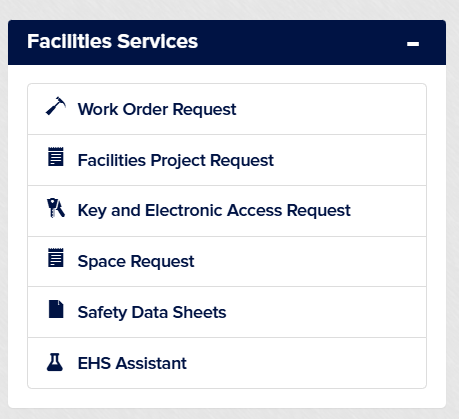
- Coordinate access to GSs subscription to VelocityEHS Chemical Management, online provider of SDS for all GS employees and accessible through the Safety Data Sheets link at the myGeorgiaSouthern homepage
- Upon request, provide documentation of employee Right-to-Know training from the GS HR or unit manager training records; and
- Maintain and compile the hazardous chemical list for GS hazardous chemicals and provide this list to the University System of Georgia twice per year.
7.2 GS Human Resources
GS Human Resources will provide access to the basic Right-to-Know training during the onboarding procedure to each new employee.
7.3 Administrative Personnel
It is the responsibility of Chairpersons, Supervisors and Program Directors to ensure that each academic or administrative unit under their authority conducts its operations in accordance with all applicable laws, regulations and USG and GS policies. This responsibility includes, but is not limited to, ensuring the use of appropriate safety practices, equipment, and facilities in activities under their authority; establishing safety programs (including safety committees) in their school, department or center; and implementing specific school, department, or center-level policies and procedures for safety and compliance.
7.4 Principle Investigators, Laboratory Supervisors and Work Area Supervisors
- Ensure elimination, substitution, and minimization techniques are implemented to reduce risk associated with the use and management of hazardous chemicals
- Maintain accurate chemical inventories EHSA for the locations over which they have responsibility;
- Properly train all employees in the work area on how to obtain SDS through VelocityEHS Chemical Management accessible at the Safety Data Sheets link on the myGeorgiaSouthern homepage. . SDS can also be obtained directly from the vendor. Employees can contact their safety personnel or Industrial Hygiene at labsafety@georgiasouthern.edu for assistance in obtaining an SDS;
- Provide oversight, technical guidance, and training to employees regarding chemical hazards to which they might be exposed to in the work area;
- Provide oversight, technical guidance, and training to employees regarding appropriate selection, use, and maintenance of personal protective equipment for the hazards present in the work space;
- Ensure standard operating procedures (SOPs) are developed and readily available and training is conducted for particularly hazardous substances used and stored in the laboratory. Ensure SOPs and training records are maintained.
- Ensure all hazardous chemicals remaining on property as a result of a separation of faculty or staff, or vacating or reassignment of an assigned space, are managed in accordance with appropriate procedures.
8. Procurement of Hazardous Chemicals
The GS Chemical Hygiene and Safety Plan requires procurement of chemicals through the GS eprocurement system. All hazardous chemicals purchased must be barcoded and entered into the Environmental Health and Safety Assistant program linked on the myGeorgiaSouthern homepage. All campus units must order chemicals following established USG and/or GS policies and ensure that SDS are available to all potentially exposed employees.
9. Safety Data Sheet (SDS) Availability
Any employee of GS has the right to examine and obtain the SDS for the hazardous chemicals to which he/she is, has been, or may be exposed. Principal Investigators, Laboratory Supervisors, and Work Area Supervisors are responsible for ensuring availability of SDS for employees in their work areas for review during each work shift, including both immediate access to necessary information in an emergency and daily access to all information as a reference source.
A SDS may be designed to cover groups of hazardous chemicals in a work area to address the hazards of a process rather than an individual hazardous chemical.
There are several ways by which a work area may meet the requirement to provide access to the SDS for hazardous chemicals present in the space.
9.1 Hard copy
Work areas without electronic access to SDS or that choose to only have hard copies of SDS shall maintain SDS in alphabetized form as hard copies in a binder. To ensure immediate accessibility, SDS binders must be visible and available to all employees and emergency personnel. SDS’s must be added to the binder immediately upon receipt of the chemical.
9.2 Electronic copy
- Work areas are permitted to keep electronic copies of SDS for hazardous chemicals present in the space as a means for all employees to have ready access to the SDS at all times.
- A work area may provide access to SDS via the internet through EHSA and Safety Data Sheets both accessible on the myGeorgiaSouthern homepage in lieu of hard copy SDS.
- A work area may use a computer or laptop located in the work area to access SDS online. The computer or laptop does not need to be dedicated exclusively for access to SDS.
- Faculty, staff, and other personnel may use personal laptops, mobile devices and/or electronic web connected devices to access SDS at EHSA or Safety Data Sheets.
9.3 Access to SDS during an Emergency
During an emergency, GS personnel in a work area may lose electric power and/or access to the internet, or may need to evacuate a work area.
During an emergency or in an event in which access to SDS is hindered, GS personnel may contact the Poison Control Center (PCC) at 1-800-222-1222. The PCC has access to a large database of SDS.
It is important to have the known chemical name and concentration at the time of the call to assist the operator with locating the needed SDS.
10. Container Labeling
10.1 Original Containers: Any GS employee ordering a chemical for their work area shall ensure that all containers received for use will:
- Clearly identify the contents
- Display appropriate hazard warnings
- List the name and address of the manufacturer
10.2 Temporary/Secondary Containers (Includes hazardous waste at satellite accumulation areas): The supervisor in each work area is responsible for ensuring that all temporary/secondary containers holding hazardous chemicals are labeled to:
- Clearly identify the contents – full chemical names
- Hazard warnings
- The date made for usable materials
An employee shall not be required to label temporary containers into which hazardous chemicals are transferred from labeled containers provided that the hazardous chemicals transferred to the temporary containers are intended only for the immediate use by the employee who performs the transfer or who is present at the time of such transfer.
10.3 Unlabeled Containers:
If an employee finds a container unlabeled or defaced, the employee needs to immediately notify their work area supervisor. If the supervisor is unable to identify the contents, the supervisor should immediately contact Industrial Hygiene at labsafety@georgiasouthern.edu.
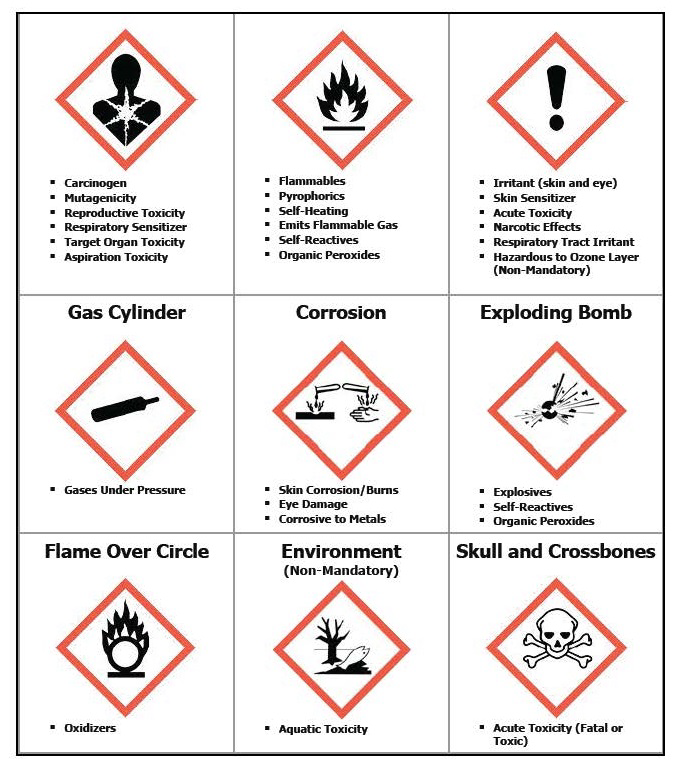
11. Hazardous Communication Pictograms and Hazards
12. Employee Training
12.1 Basic Employee Right-to-Know training:
Prior to work with hazardous materials, new GS employees must receive Right-to-Know training. This training is required annually for all employees as per State of Georgia Public Employees Hazardous Chemical Protection and Right-to-Know Act of 1988 – O.C.G.A. § 45-22-6.
The training is computer-based and is part of new employee orientation. In some circumstances, other formats are available. Documentation of basic training is maintained by Environmental Health & Safety. This basic training informs each employee of their rights under the law, additional training requirements under the law, and where to go for additional information concerning the Right-to-Know Plan.
12.2 Chemical-Specific Right-to-Know Training:
Those GS employees who are exposed to hazardous chemicals during the normal course of their employment must be provided with additional training called Chemical-Specific Right-to-Know Training. The work area supervisor of such an employee will ensure that chemical-specific training is provided prior to working with any hazardous chemical and that such training is refreshed annually. In accordance with Board of Regents policy Number 0472-1 3-027, written documentation of chemical-specific training must be maintained for a minimum of thirty years after separation of the employee from GS.
Additional chemical-specific training must be provided prior to the introduction of any new chemical hazard or if there is a significant increase of an existing hazard in the employee’s work area. The work area supervisor of the affected employee must ensure that such additional training is provided and documented. Particularly hazardous substances require written standard operating procedures. Particularly hazardous substances (PHS) are those chemicals with special acute or chronic hazards. The OSHA laboratory Standard (29 CFR 1910.1450) defines PHSs as select carcinogens, reproductive toxins, or substances which have a high degree of acute toxicity. Chemical specific training content outlined below must be incorporated into each SOP for particularly hazardous substances.
12.3 Chemical-Specific Training Content: Training programs must be tailored to the specific nature of each individual workplace and the educational levels of the employees. Chemical-specific training information may relate to an entire class of hazardous chemicals when it is appropriate and related to the job. Chemical-specific training must minimally explain the following per O.C.G.A Title 45-22 sections 1-12
- The requirements of the Right-to-Know Act;
- The location and content of the GS Right-to-Know Plan;
- Chemical specific standard operating procedures;
- Hazardous chemicals present in their workplace;
- The physical hazards and health effects of the chemicals;
- Any operations in their work area where hazardous chemicals are used;
- An explanation of any special labeling present in the workplace;
- − What are pictograms?
- − What are signal words?
- − What are hazard statements
- − What are precautionary statements
- Methods and observations used to determine the presence or release of the chemicals in the work area, e.g., air sampling, spot check monitoring, continuous monitoring, or methods of visual or olfactory detection;
- How to lessen or prevent exposure to these chemicals by proper work practices and the use of personal protective equipment;
- How employees can obtain and use appropriate hazard information
- How to understand and use the information on labels and safety data sheets; and
- Emergency procedures to be followed in the event of exposure, spill, fire or disposal.
12.4 Training Format:
All training sessions must include an opportunity for employees to ask questions. Any employee who did not receive either basic training or chemical-specific training prior to initial assignment must do so immediately. Principal Investigators, Laboratory Supervisors and Work Area Supervisors must review and verify that current employees have received Right-to-Know training. The GS Chemical Hygiene Officer is available for training consultation and assistance.
12.5 Employee Information Poster
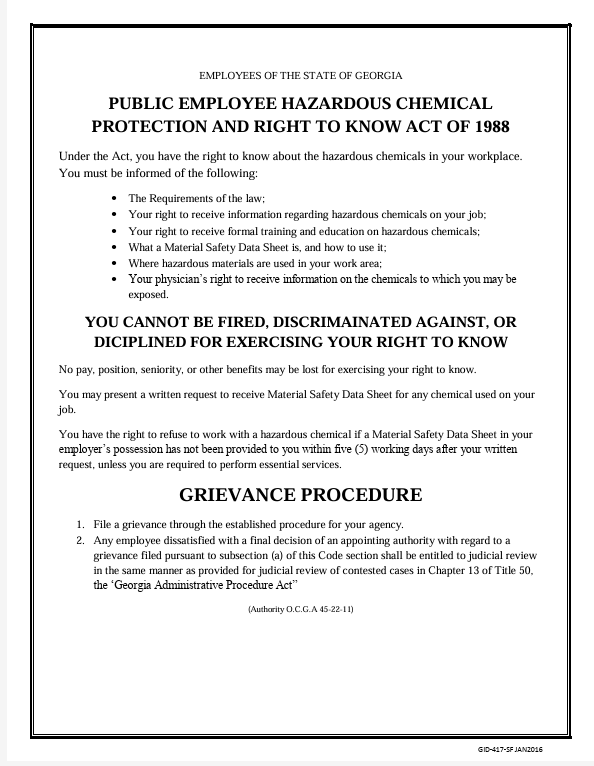
A poster describing employee rights under the Act must be posted in a prominent manner in the workplace where notices are normally posted so that it is visible to all employees on a routine basis. A copy of the poster may be downloaded at https://doas.ga.gov/human-resources-administration/workplace-posters or by contacting the GS Chemical Hygiene Officer at labsafety@georgiasouthern.edu for assistance.
13. Contractors and Hazardous Chemicals
Any contract with GS which may involve hazardous chemical exposure to GS employees requires that independent contractor and subcontractor(s) to:
- Notify the GS workplace or work area manager at least 30 days prior to commencement of work with any hazardous chemical which will be used or stored at the work-site by the contractor or its sub- contractors. (This 30-day requirement may be waived in the event of an emergency).
The workplace or work area manager will then:
- Disseminate this information to the employees whose workplace is at the work-site;
- Obtain SDS from the contractor for those hazardous chemicals and make them readily available to GS employees during the contractor’s presence at the work-site;
- Acquire documentation from the contractor that its employees and sub-contractors have been provided with information and training on hazardous chemicals being used by the contractor or its sub-contractors at the work-site; this documentation should include the written Hazard Communication Plan and documentation necessary to ensure compliance with all rules, codes, standards and regulations governing environmental health and safety.
Any independent contractor or subcontractor working with GS may request in writing and has the right to examine the SDS for those hazardous chemicals to which he/she or his/her employees are, have been, or may be exposed.
14. Hazardous Chemical Lists
In January and July of each year, the Chemical Hygiene Officer will provide a list, by name, of all hazardous chemicals or products present in GS workplaces to the USG Environmental Health & Safety Official. Only chemicals defined as hazardous are required to be reported. This includes any material labeled as flammable, explosive, combustible liquid, corrosive, reactive, oxidizer, toxic, water reactive, pyrophoric, or organic peroxide.
Chemical inventories maintained through EHSA are used to provide this report. The EHSA database is maintained through the GS Chemical Hygiene Officer and is available for use by all GS operating units.