Building teams and belonging: Dorsey Howarth’s journey to becoming a champion for student wellness
For recent Georgia Southern graduate Dorsey Howarth, the transition from high school sports fields in Decatur, Georgia, to Georgia Southern University’s Statesboro Campus wasn’t just about finding a classroom, it was about finding a team.
Having spent years on soccer and lacrosse fields, the isolation of a solo gym workout felt foreign. She craved the team energy she had before, a need that led her to a small group training class at the Recreation Activity Center (RAC) through Campus Recreation and Intramurals (CRI) during her sophomore year.
There, she didn’t just find a workout; she found her true calling and academic path.
“I loved the group energy and sense of community in my fitness classes so much that I wanted to help others find that feeling as well,” Howarth explained.
The desire to cultivate belonging sparked a rapid transformation.
“By that spring, I transitioned from class participant to class leader and chose to pursue a degree in recreation, tourism and event management,” said Howarth. “I realized that I enjoyed bringing diverse groups together and wanted to turn my passion into my profession.”
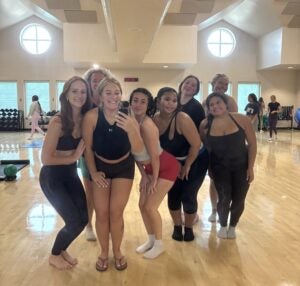
After earning her group exercise national certification, she officially stepped into the role of group fitness instructor, determined to make everyone feel welcome in her classes. Her unique relationship-oriented leadership style blended fitness instruction with the feeling of being on a team.
Howarth soon realized the traditional hour-long class sessions were often a barrier for beginners.
“I felt like the hour classes were intimidating for people,” Haworth explained. “An hour can feel like an eternity if you’re just starting out, and I wanted my classes to be completely inclusive.”
Her solution was the creation of a new signature format that split the standard hour into two focused, 30-minute, high-intensity sessions called “Arms and Abs” and “Glutes and Guts.” This bite-sized approach allowed students to build confidence without feeling overwhelmed. The change was an instant hit, quickly drawing 25-30 participants per session and proving that fitness is most effective when it’s accessible.
Howarth’s influence soon expanded beyond the fitness rooms. She took on new roles as a small group trainer and CRI social media manager, leveraging digital platforms to dismantle the “gym-timidation” she once feared. By introducing “Meet the Instructor” segments and collaborating with other campus groups on events like “Take Back the Night,” she turned CRI’s social media feed into a welcoming space for all students.
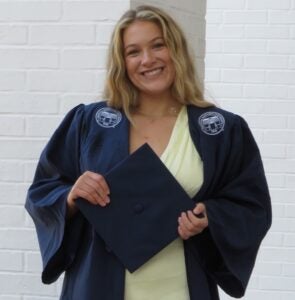
“Recreation isn’t just about what happens inside the facility. It’s about building connections outside of it,” Howarth said. “Using social media allowed us to meet students where they already were, breaking down walls and turning CRI into a true campus community.”
Howarth’s recreation management classes helped to broaden the skillset needed to go from leading fitness classes to shaping community-wide wellness initiatives. Her leadership capabilities took center stage during the True Blue 5K, where she managed more than 50 volunteers showcasing a collaborative spirit and ability to organize and energize large groups.
Her impact in CRI and across campus did not go unnoticed, and she earned the National Intramural and Recreational Sports Association (NIRSA) Watson Award for excellence in campus recreation as well as the Leader of the Pack Award voted on by her peers.
These natural leadership instincts found their foundation in the classroom, where Howarth’s education provided the strategic blueprint for her future. By blending recreation, tourism and event management theory with her real-world experience at CRI, she is ready to step seamlessly into the professional world after graduation.
Howarth’s time at Georgia Southern taught her that leadership isn’t just about leading a class or directing an event; it is about using recreation to design and create spaces and experiences that bring diverse groups together.
“My journey in recreation started because I missed the energy of a team,” she said. “Through my academic and CRI experiences, I not only found a team, I learned how to build one that brings people together to achieve their health and wellness goals.”