
Sexual & Reproductive Health

Wellbeing & the GSM Community

Our goal is not to re-invent the wheel but, rather, to invite you to explore the many wonderful resources already in existence, nationwide. Please peruse this section for more information on LGBTQIA+ sexual health, in addition to information on LGBTQIA+ general health and wellness. If you don’t see what you specifically looking for or have a resource that you think could be helpful to add to our list, feel free to contact wellbeing@georgiasouthern.edu .

Gay & Bisexual Men’s Health & Wellness

Transgender Health & Wellness

LGBTQ Campus Resources:

Gay Straight Alliance

Facebook group: Rainbow Statesboro

GSA official email: thegsaofgsu@gmail.com

The Multicultural Student Center

Located on the second floor of Russell Union

Alphabet Soup

(Faculty/Staff organization)

Contact: Dr. Jeff Jones, Assistant Professor in Jiann-Ping Hsu College of Public Health, at jajones@georgiasouthern.edu

The Equal Opportunity & Title IX Office

Located in the Rosenwald Building, Room 1066

Phone: 912.478.5136

Counseling Center

Located on Forest Drive between Health Services and the Forest Drive Building

To schedule an intake appointment, please call 912.478.5541

Safer Sex Supplies

  • Statesboro: Condoms are available for free at Health Services Pharmacy Monday through Friday, 8am – 12pm and 1pm – 5pm. 
  • Armstrong: Condoms are available for free at Health Services Check In Desk Monday through Friday, 8am – 12:30pm and 1:30pm – 5pm. 

Bulk Supply Requests

If you would like to request a bulk order of condoms for your organization, program, or event, please complete the following request form here from Health Services. Bulk condom requests will be filled on a case-by-case basis and while supplies last. Please allow 3 business days to process requests.

Please note that this form is for bulk requests for distribution only. Safer sex supplies for personal use, including male and female condoms, lube, and dental dams, are available from the Health Services Pharmacy, as supplies last, and Student Wellness and Health Promotion.

Free HIV Screening Clinics

1 in 7 people infected with HIV don’t know they have it. Know your status! The CDC recommends that everyone between the ages of 13 and 64 be tested for HIV at least once as part of routine health care. A general rule for those with risk factors is to get tested annually.  Our office has partnered with the Department of Public Health to offer free testing events at Georgia Southern.

Return here or follow us on social media for upcoming testing dates!

Period Equity Movement

What is the Period Equity Movement (PEM)? 

The Period Equity Movement is a multi-campus initiative led by students, staff, and faculty to promote period equity. We aim to ensure that individuals who menstruate have the products they need to live their lives to the fullest. 

PEM consists of: The Green Period Pantry, The Disposable Period Pantry, and Period Products On the Go sites across all three Georgia Southern campuses, and includes comprehensive medically accurate and culturally relevant reproductive health peer certificate and engagement events.
The Disposable Period Pantry allows student to access a month’s supply of disposable products such as tampons and pads.

The Green Period Pantries provide students with access to reusable products such as cups, period underwear, and reusable pads.

Disposable period products are available for students to take as needed in restrooms on all three campuses.
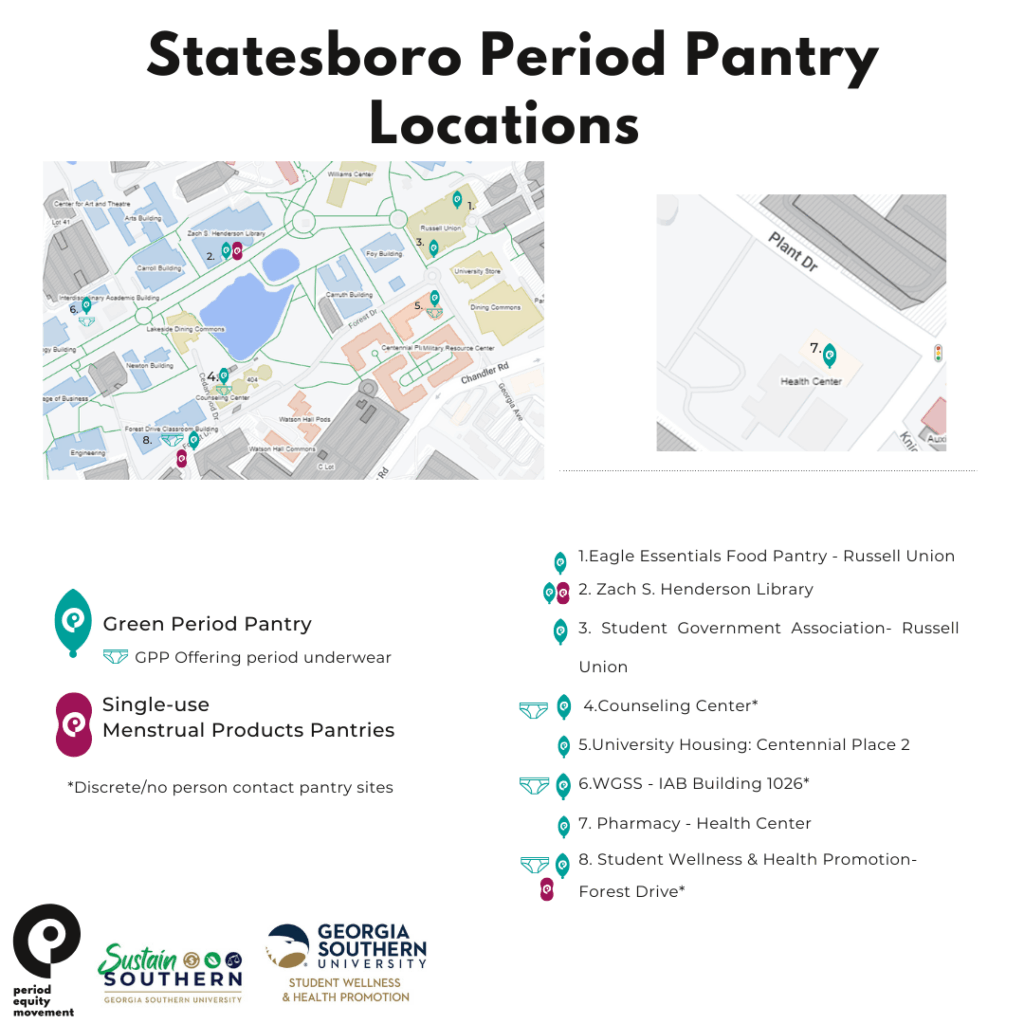
Map of Georgia Southern University’s Statesboro Campus showing period pantry locations.
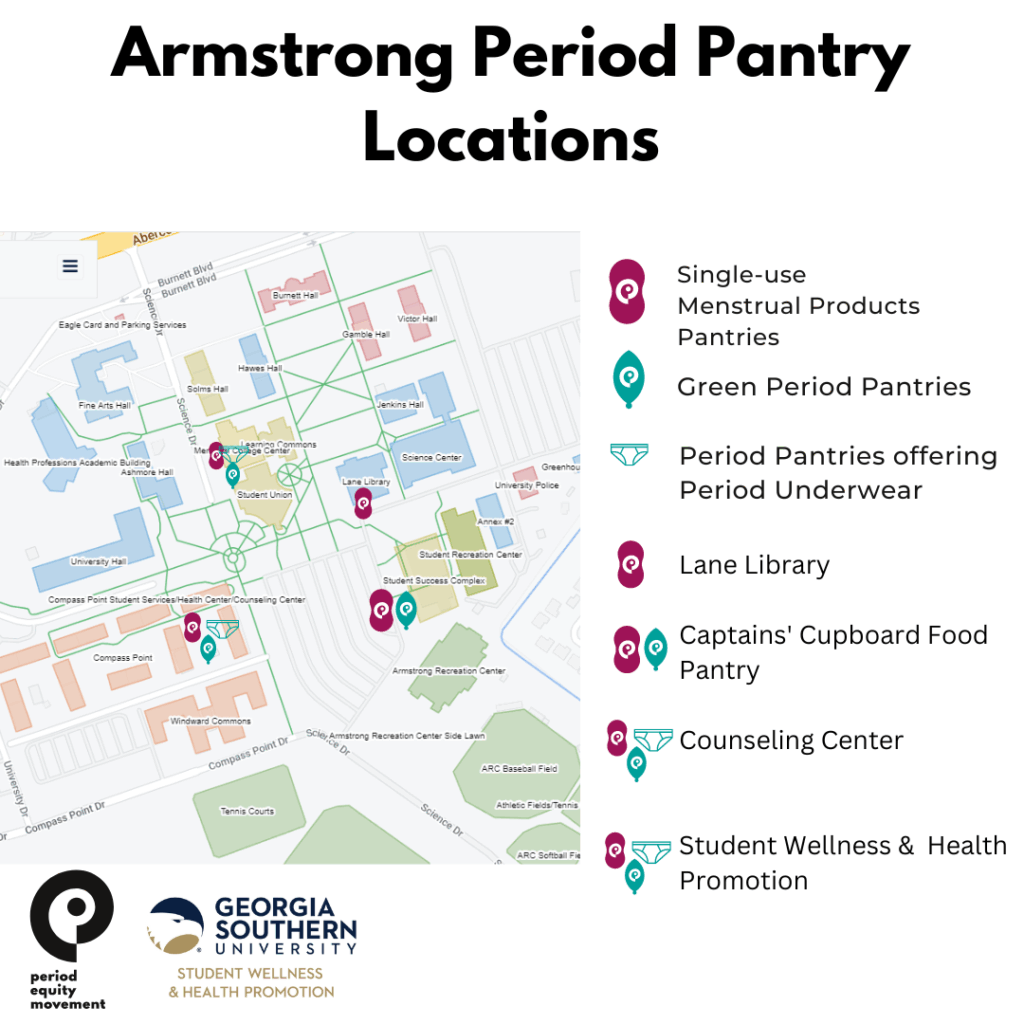
Map of Georgia Southern University’s Armstrong Campus highlighting locations of period pantries.

According to the 2021 State of the Period

  • 84% of students who menstruate in the U.S. have missed class time or know someone who has missed class time because they did not have access to period products.
  • 69% of menstruators feel embarrassed when have to bring period products to the restroom.
  • 1 in 5 menstruators from ages 13-19 have struggled to afford period products or were not able to purchase them at all.
  • 1 in 10 college students experience period poverty. 
  • Period poverty has been defined by the American Medical Women’s Association as inadequate access to menstrual hygiene tools and education.