
College of Science and Mathematics secures $250,000 grant to aid neuroscience, cell biology and cancer research
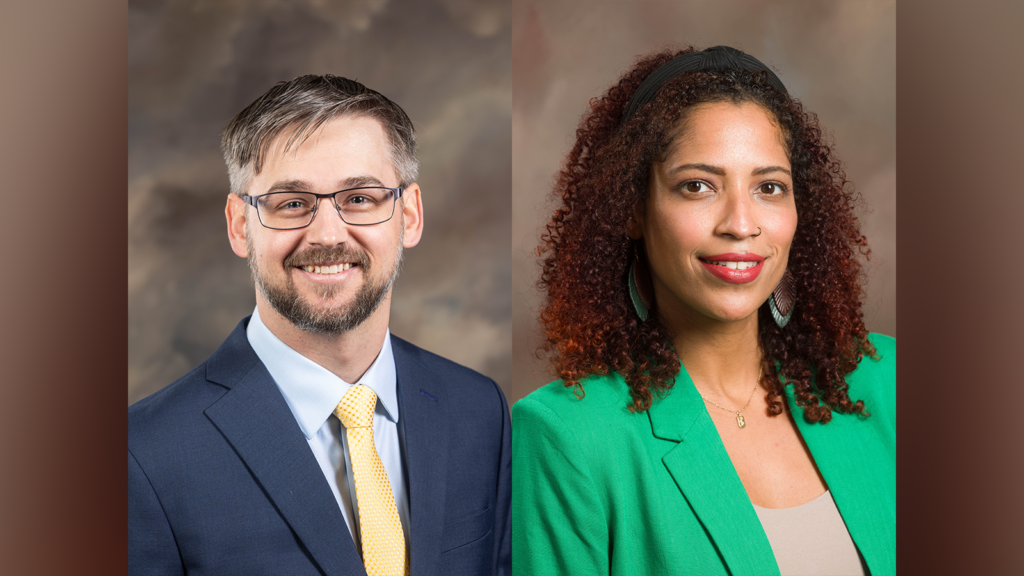
Cristina Roman-Vendrell, Ph.D., couldn’t be more excited about the latest piece of advanced technology coming to the Science Center at Georgia Southern University’s Armstrong Campus in Savannah.
The new ECHO Spinning Disk Confocal microscopy system is a sleek piece of equipment, consisting of two main units. The black-and-white spinning disc unit on one side handles high-speed imaging to support viewing from the ECHO Revolution microscope on the other side. It has automated microscopy techniques that allow for real-time viewing across multiple focal planes.
This is especially helpful for Roman-Vendrell’s research, which focuses on neurodegeneration in living tissue.
“There’s so much that we don’t know about how our cells work,” said Roman-Vendrell, an assistant biology professor in the College of Science and Mathematics (COSM). “Using this type of microscope allows us to probe into what is happening. That way, we can understand disease and develop drugs that can potentially improve quality of life for people suffering from neurodegenerative diseases.”
These are debilitating diseases, such as Alzheimer’s, Lewy body dementia and Parkinson’s, the latter being one that Vendrell knows all too well.
“One of my dear family friends was diagnosed with Parkinson’s disease,” she said. “Seeing how the disease affected her life motivated me to pursue this research that could help us better understand these disorders and potentially contribute to developing treatments.”
The ECHO is more than a high-tech tool for Roman-Vendrell’s research. Its purchase, made possible thanks to a $250,000 grant from the National Institutes of Health (NIH), is meant to support Georgia Southern’s burgeoning biomedical program.
“The program at Georgia Southern is growing at a rapid pace,” said Stephen Greiman, Ph.D., associate dean for research and graduate studies in COSM. “We’re hiring new faculty, and we just welcomed our inaugural biomedical sciences Ph.D. cohort. The NIH sees that and they want to be a partner in making our growth possible.”
Greiman and Roman-Vendrell attribute that growth to what the program offers students: working alongside leading researchers and using state-of-the-art equipment to find solutions to their own research challenges.
“Instruments like these show prospective students the potential of what they can experience in the program,” said Greiman. “They see the efforts Georgia Southern is making to enhance research capabilities at the university and they want to be a part of it.”
Roman-Vendrell agrees, stating that investments in the program, like the purchase of the ECHO microscope, empower students to take their research even further.
“It brings me a lot of joy to see how many students are interested in research,” she said. “To see the moment when things click for them, it’s just wonderful.”