From the lab to the marsh, Georgia Southern students lead summer science research
As summer heat settles across the region, students in the College of Science and Mathematics (COSM) at Georgia Southern University are completing research projects from the laboratory to the salt marsh.
A window to the future
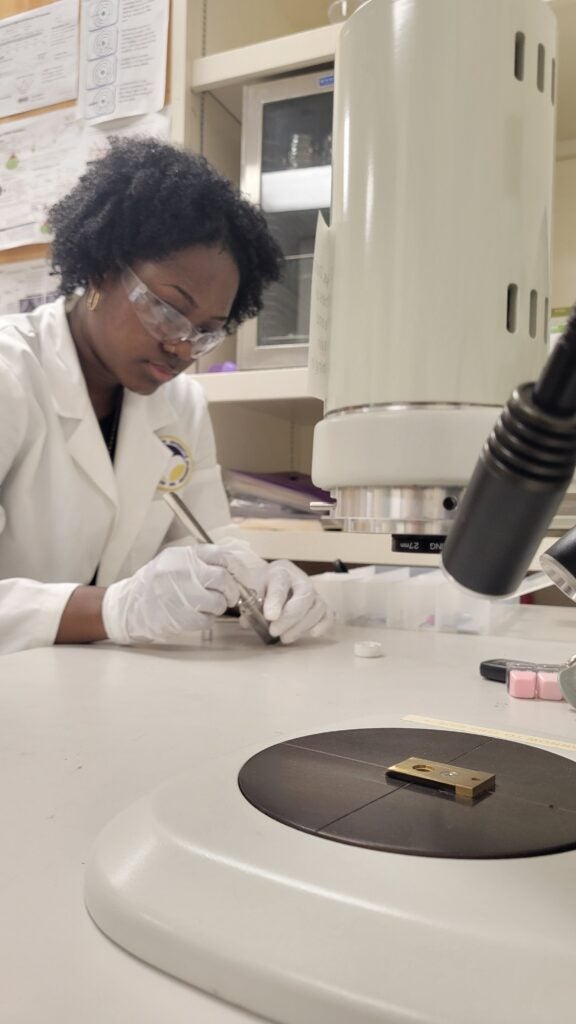
Kenadee Jones is working on smart window technology in the labs inside the Nursing/Chemistry Building on the Georgia Southern University Statesboro Campus. Using advanced materials like vanadium dioxide, Jones is researching how windows can adjust to allow different amounts of infrared (IR) radiation into a room without changing how much visible light comes through. The result would be windows that control how much of the sun’s natural heat enters a room without changing how bright it is inside.
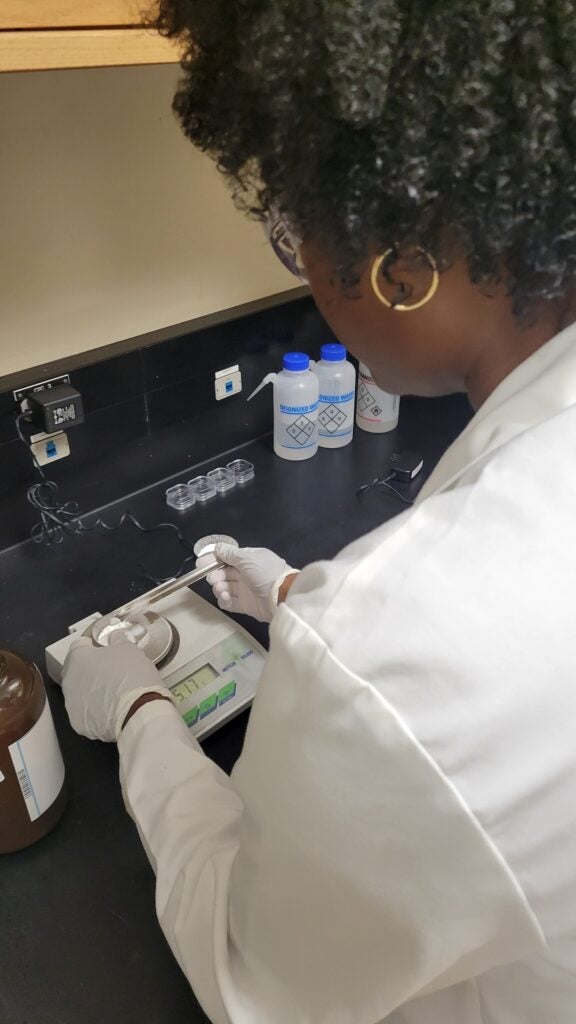
“Once the outside reaches a certain temperature, let’s say 70 degrees Fahrenheit, it optimizes to allow visible light through, but it reflects a lot of IR radiation back,” said Jones. “That means we don’t get as much heat through the window, which gives the feeling of a cooler room. It would also work in the reverse by allowing more IR radiation into the room to warm it back up if the room became too cool.”
This kind of hands-on research is exactly why Jones chose the Applied Physical Science program at Georgia Southern for her master’s degree.
“During my undergrad, I realized that I had a really big passion for chemistry, but specifically materials and coatings,” said Jones. “When choosing a master’s program, Georgia Southern was kind of a no-brainer because they have a specific concentration for materials and coatings. I was super interested in this specific project because it’s so applicable to everyday life, and it’s also something that has a lot of potential to help with energy conservation, which is a really big topic right now.”
Growing a new discovery
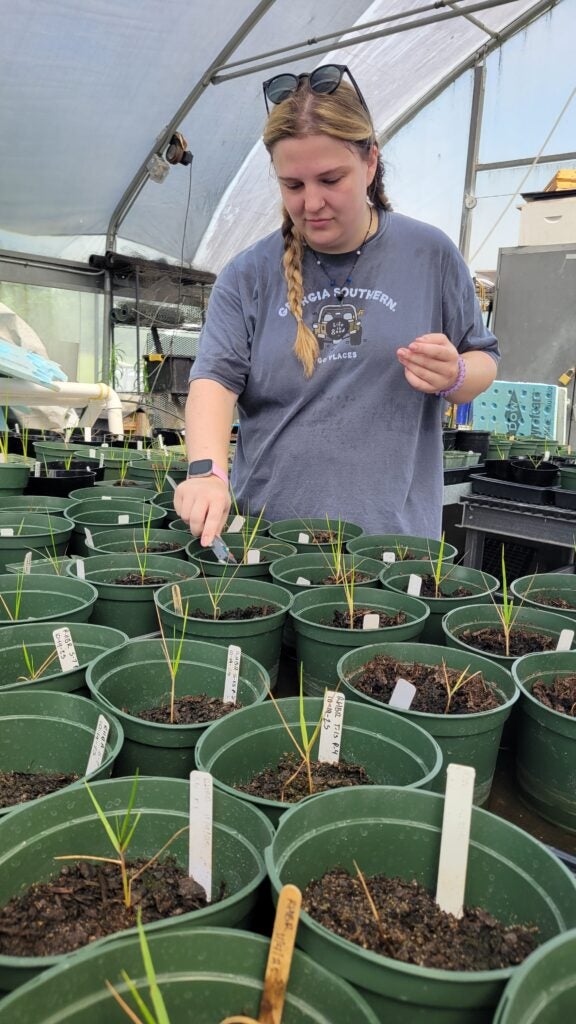
Environmental science doctoral student Sara Ward spends her summer days in the greenhouse on the Armstrong Campus in Savannah nurturing Spartina grass. While the grass is known to grow in two distinct strains (tall and short) it is unknown whether they are distinct genetic species or if environmental factors cause the grass to grow differently in different areas.
“We were doing a lot of background research on Spartina in class and we found a big gap in the existing research,” said Ward. “I kept asking all these questions to Dr. Heather Joesting and she said ‘I think this could be a project for you to be the first one to figure this out.’ I realized that nobody had answered the question. Nobody had written anything yet.”
That kind of support from faculty made all the difference in Ward’s education. Originally an undergraduate student at the University of Tennessee, Ward struggled and thought a college degree might not be in her future. She transferred to Georgia Southern, earned her bachelor’s, then continued on to the Ph.D. level.
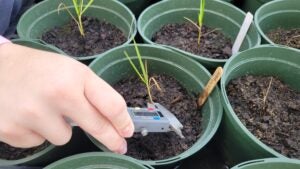
“I was feeling really uninspired about school until I transferred to Georgia Southern,” said Ward. “I felt like the professors cared about me being here and that did so much for me. I took plant ecology with Dr. Joesting and it inspired me. Then I did a semester-long research project that launched me into wanting to do this Spartina project. I literally would not be doing any of this if it wasn’t for coming to this school and being in her classes.”
Supercharging Spartina
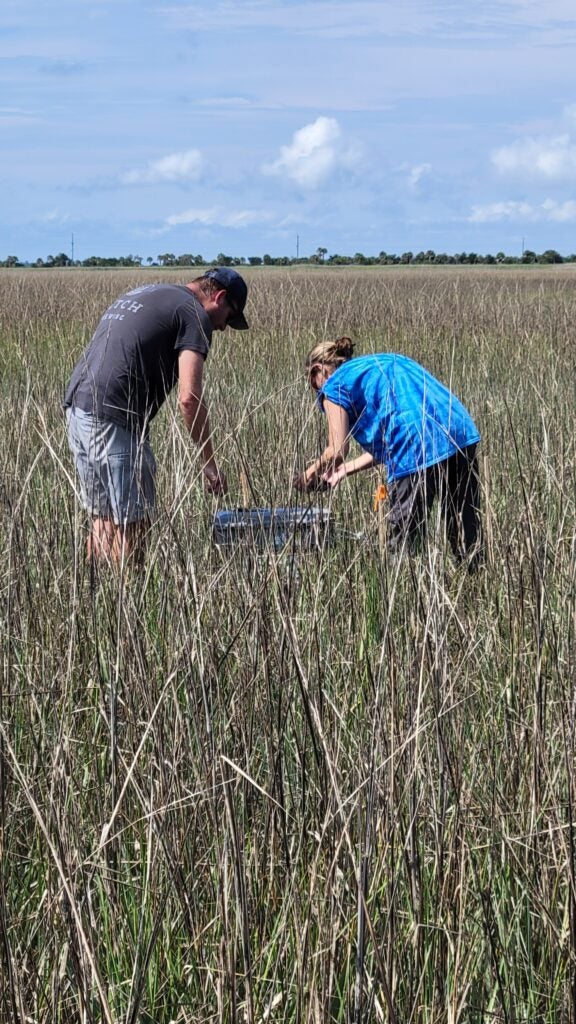
Biology students Kayla Koory and Dex Bloodworth trek through the marshland surrounding historic Fort Pulaski every week to monitor the native Spartina grass that grows there. Koory is studying the effects of carbon-capturing additives like olivine to see if the marsh can become a turbocharged pollution cleaner without damaging the delicate ecosystem. The work is part of Koory’s thesis in the Master of Science program while Bloodworth, a Bachelor of Science student, is assisting through the COSM Office of Undergraduate Research (COUR) Summer Undergraduate Research Fellowship (SURF).
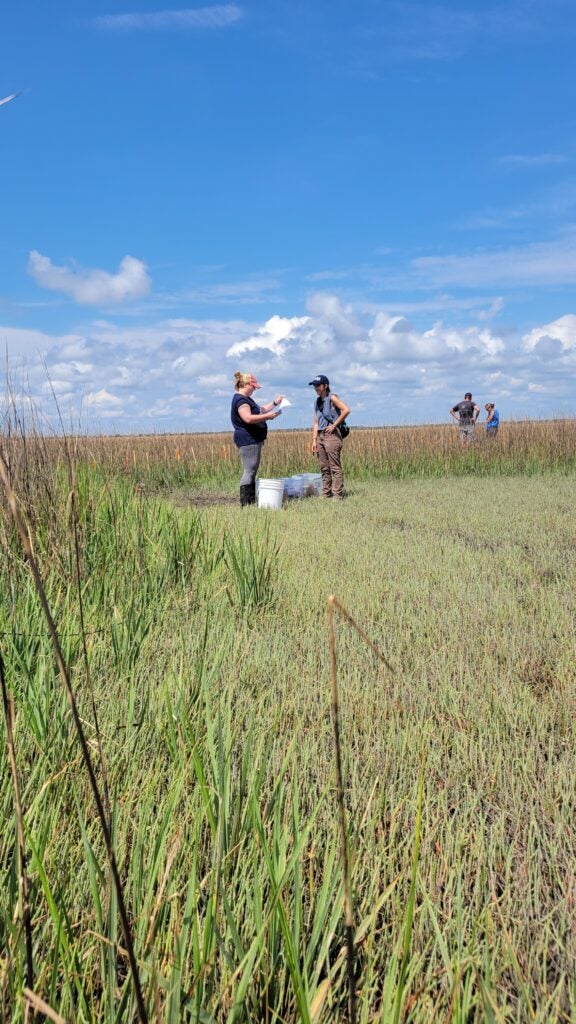
Bloodworth says the unique opportunities provided through SURF are a huge enhancement to a typical bachelor’s degree.
“It’s really cool to have an opportunity like this as an undergraduate,” said Bloodworth. “You usually hear about master’s and Ph.D. students doing all the heavy fieldwork, so getting to join them to be part of it early on is great and sets me up for what I want to do in the future.”
Koory loves that Georgia Southern’s commitment to coastal resiliency and the support from faculty to pursue passion projects converged into a dream scenario of conducting original marshland research.
“When I started looking into going back to grad school, I knew I was interested in the environment and I’ve always had a big passion for the salt marsh,” said Koory. “This was the perfect project for me to get started in my own research.”
Bloodworth says students and faculty create a shared environment that makes learning exciting.
“I learn a lot from the people I work with and everybody is really awesome to me,” said Bloodworth. “It’s like I finally found my community. Being able to get out there and do all of this, especially while I’m still an undergraduate, I know that this is what I want to do for the rest of my life and I know that I’m not wasting my degree.”