
Molds, mildews, mushrooms and more: Georgia Southern professor lands grant funding for an innovative and accessible fungal curriculum and genomics project
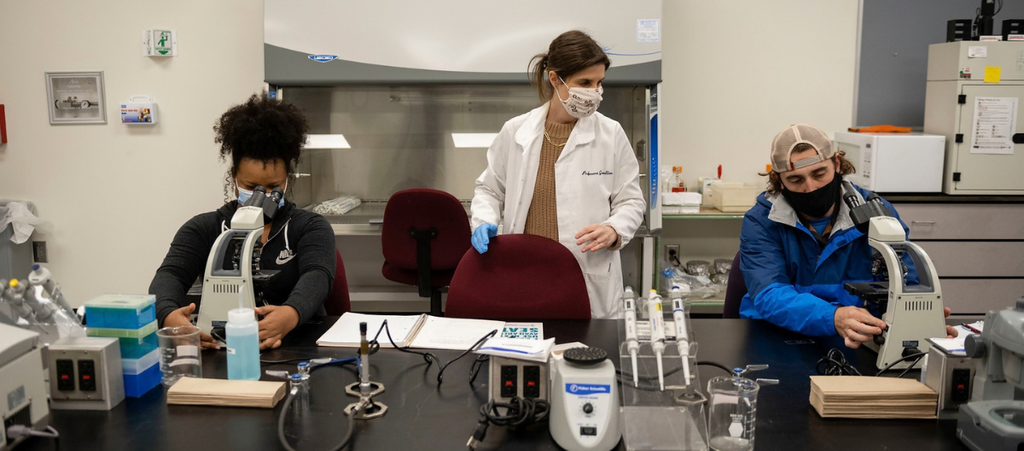
Georgia Southern Department of Biology Professor Sara Gremillion, Ph.D., has taken on a cross-institutional, five-year National Institute of Health grant-funded project that aims to create a curriculum and shared knowledge pool for an underutilized, yet widely available organism: Fungi.
Gremillion, who is also the Interim Associate Dean of Faculty Affairs and Student Success in the College of Science and Mathematics, explained, “I’m a mycologist, a biologist who studies molds, mildews, mushrooms and things like that. I am really interested in fungi that cause plant disease. I’m also interested in fungi that have medically important characteristics like the ability to produce antibiotics.”
The project, Myco-Ed: A National Platform Bringing Fungal Genomics to the Future Biomedical Workforce, led by Gremillion, is a culmination of mycological expertise from across the globe designed to increase biomedical knowledge through an accessible, collective database of fungal research. But the project isn’t just an encyclopedia of fungal research; it also centers around teaching strategies for educators who may not have intensive training in mycology.
Gremillion said, “There aren’t many people who study fungi, despite their importance in ecosystems, health and industry. So, our goal is to approach the microbiologist who may be studying bacteria, or the ecologists who may be studying plants in a specific ecosystem and pull them into the project. We’ll train them in a fungal-forward curriculum-based undergraduate research experience (CURE) to include in their courses.”
By training fellow scientists to implement a mycology-based curriculum, student and career researchers can work toward contributing fungal genetic information to a free, online database that can easily be accessed and used to further conversations surrounding biomedical potential for a wide variety of fungi, collected from nature by students.
As a longtime professor of biology on the Armstrong Campus of Georgia Southern, Gremillion has long been a supporter of undergraduate research opportunities. For the principal investigator and adjoining investigators, the inclusion of non-graduate-level scholars also plays a major role in the project through the Course-based Undergraduate Research Experience (CURE) curriculum.
“When you’re majoring in STEM, your undergraduate laboratory experience is where the intense learning happens. It’s the hands-on activities that help you solidify those concepts. They help you learn how science is actually done. And so, to me, when I take on a research student, it’s just one-on-one teaching. Teaching a CURE is the next best thing; a classroom of students gets that research-intensive experience,” Gremillion stated.
Ultimately, the almost $1.6 million grant will allow educators and scholars to investigate fungi as an innovative resource for beneficial usage as well as potential health risks. Although fungi are widely overlooked despite their natural abundance, the Myco-Ed project will provide training and knowledge to better understand these widespread organisms. With a mycologically literate biomedical workforce, fungi can be studied and leveraged for a variety of uses in the prevention of disease and production of improved, fungal-derived medicines.
For Gremillion and her collaborators, this project is the outcome of a long-held dedication to the far too understudied world of mycology, where fungi are no longer hiding beneath hidden surfaces or in the dark corners of a basement, but taking center stage in the world of biomedical discovery.
“Fungi are so cool,” she said. “Don’t sleep on the fungi.”